How to Check If Your City Declared a State of Emergency
The three kinds of declaration in Canada, where to look each one up, and what it actually means
“State of emergency” sounds dramatic, and the phrase turns up in the news every wildfire and flood season. It does not always mean what people assume, though, and Canada actually has three versions of it, declared by three different levels of government. To find out whether your own community is under one, you first need to know who would have declared it and where they post it.
We put this together to make that simple. Below we walk through the three kinds of declaration, how to check for each in a few minutes, and what one actually changes for the people living under it. One thing we’ll settle up front: in Canada, a state of emergency is not a request for money. It is a grant of extra powers.
The shape of it, in a few numbers
3
levels of government that can declare a state of emergency
1
time the federal Emergencies Act has ever been used (2022)
13
provinces and territories that declared one in spring 2020
7–14 days
how long a local declaration usually lasts before renewal
30 days
length of Manitoba’s province-wide wildfire emergency in 2025
55 of 65
major cities CityWatch tracked under a local emergency in 2020
Three levels, three declarations
Three different governments can declare a state of emergency, and they rarely declare the same one. Knowing which is which tells you exactly where to look.
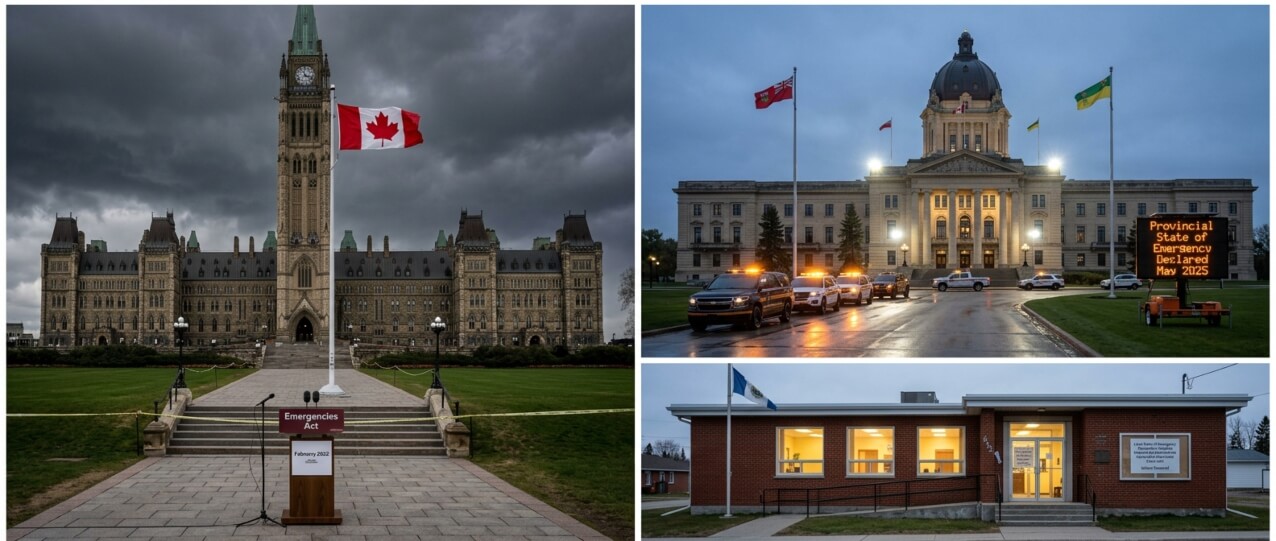
Federal – the Emergencies Act
Declared by the federal Cabinet · Confirmed by Parliament · Country-wide
The federal Emergencies Act is the heavyweight, kept for a national crisis that provinces cannot handle on their own. It has been used exactly once, during the 2022 convoy protests, and was revoked nine days later. It was not used for COVID-19. If it is ever invoked, you will hear about it everywhere.
Provincial
Declared by the premier or a minister · Each province has its own act · Province-wide or regional
Every province and territory can declare its own state of emergency under an emergency-management or public-health act. This is the level you see most in a bad fire or flood year. Manitoba and Saskatchewan both did exactly this in May 2025.
Local – your city or town
Declared by municipal council · Often 7 to 14 days, then renewed · Your community
Your own city or town can declare a local state of emergency on its own, usually through council. It is the most common kind and the one most likely to affect your street directly. In most provinces it lapses after a week or two unless the municipality renews it.
Where each one is posted
Level | Who declares it | Where you’ll find it |
|---|---|---|
Local | Municipal council | Your municipality’s website, usually an “emergency” or “newsroom” page, plus its social feeds |
Provincial | Premier or minister | Your province’s emergency-management agency, such as Emergency Management Ontario, the Alberta Emergency Management Agency, or the Saskatchewan Public Safety Agency |
Federal | Federal Cabinet | Canada.ca and national news; a federal declaration is rare and heavily covered |
How to check in a few minutes
Putting it together, here is the fastest way to find out whether a declaration is in effect where you live.
✓ Start with your municipality. Search your city or town name plus “state of emergency,” or open its official website and social feeds. A local declaration almost always lands there first.
✓ Check your province’s emergency agency. Each province posts active provincial declarations and alerts on its emergency-management site.
✓ Turn on Alert Ready. The national alerting system pushes emergency warnings, including many evacuation orders, straight to your phone. You cannot opt out of the wireless alerts.
✓ Cross-check with local news. Reporters confirm and explain declarations quickly, and they spell out what the order actually requires of you.
What a declaration does, and doesn’t
A declaration unlocks powers a government does not normally have. A municipality or province can order evacuations, close roads, control the price of essentials, or take over private property if it has to. That is the whole point of declaring one.
What it does not do is release federal money. People often assume a declaration is how a community qualifies for disaster relief, the way a US state triggers FEMA support. In Canada the two are separate. Relief programs run their own application process, and a declaration is about authority, not funding.
A live example: May 2025
Manitoba declared a province-wide state of emergency on 28 May 2025 as wildfires forced about 17,000 people from their homes, the largest evacuation in the province since the 1997 flood. Two days later Saskatchewan declared its own, with roughly 15,000 evacuated. Both ran for 30 days. This is what the provincial level looks like in practice.
Which cities declared one during COVID-19
The pandemic produced the broadest wave of declarations the country has seen. For the first time, every province and territory declared a provincial state of emergency at roughly the same time in March 2020. At the municipal level it went wider still. CityWatch Canada, which tracked the response of 65 of the largest municipalities, found that 55 of them were under a local state of emergency. The federal Emergencies Act, notably, was never used for COVID.
Frequently asked questions
No. Each province has its own law, so the powers, rules, and time limits differ from place to place.
A local declaration often lapses after 7 to 14 days unless it is renewed. Provincial ones are commonly set for about 30 days and can be extended.
Not by itself. A declaration grants the power to order an evacuation, but the order is a separate step. Watch for an evacuation order, not just the declaration.
Yes. A municipal council can declare a local state of emergency on its own.
No. The federal Act has only ever been used once, in 2022.
Related: for the platforms that track these declarations and other emergency measures across Canada, see our overview of Canada’s emergency-response tools.